What Is Regression Hypnotherapy?
How regression works, what a session is like, why it takes real skill and how hypnotherapists learn it.
By Farhan Zahid, CCHtReviewed by Randal Churchill6 min read
RG-01 · Farhan’s final text (October 12), with Randal’s review edits (October 27)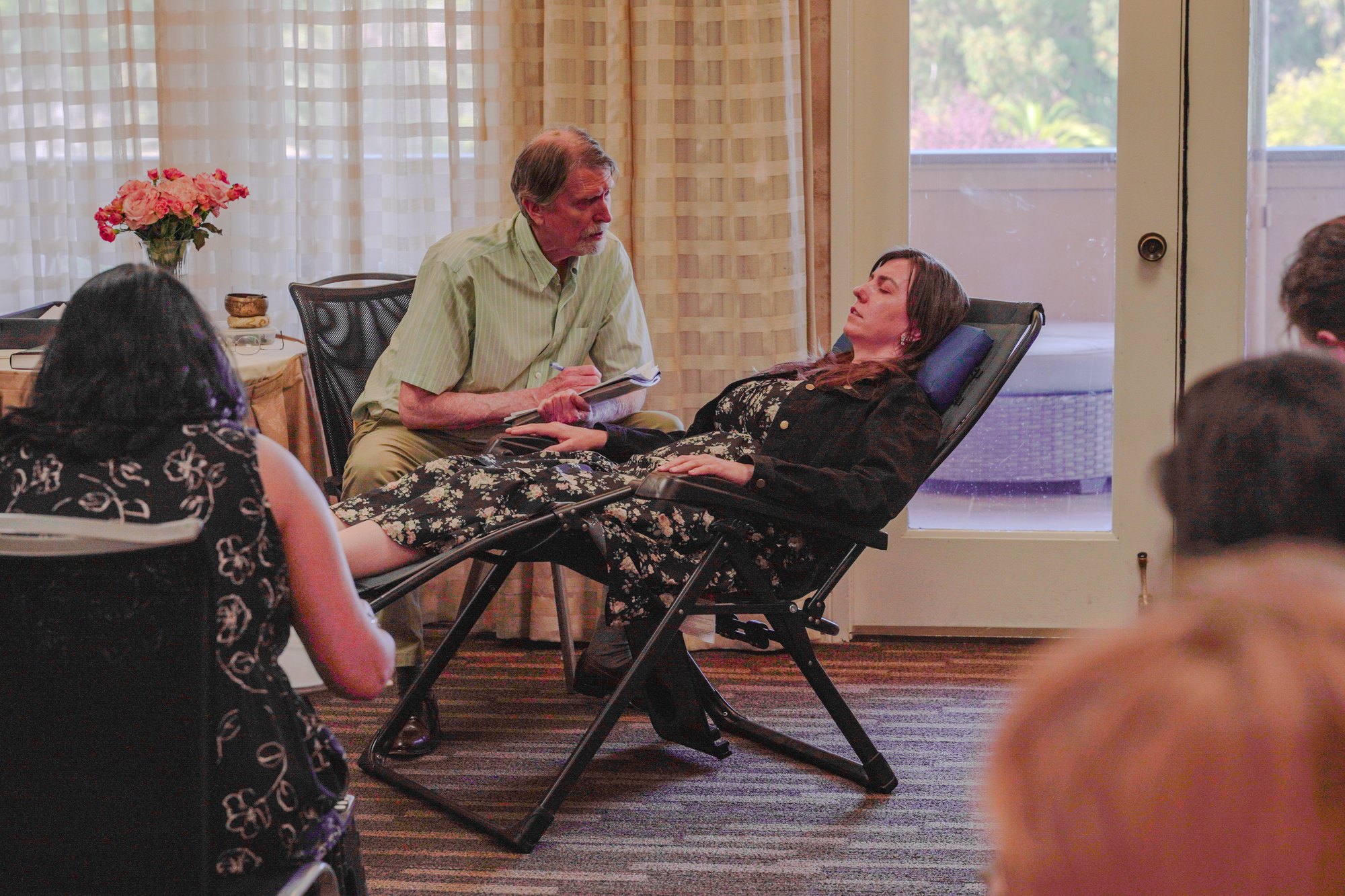 REG-01 · DSC03533, gentle exposure lift only
Most of us carry something from the past without knowing where it began: a fear stronger than the moment calls for, a reaction we can’t explain, a belief about ourselves we never chose.
An important form of regression hypnotherapy is one in which a client, in hypnosis, returns in memory and feeling to earlier experiences connected to something in their life today.
Well-trained hypnotherapists can carefully use it when a present-day difficulty seems to have roots in an earlier experience: a fear that began with a particular event, for example, or a reaction that’s stronger than the situation calls for.
What happened in the past has already happened. What matters in this work is what a person carries from those events into the here and now: the feeling, the conclusion they drew, the belief that followed. Revisiting an event, safely and with skill, can change what they carry forward.
| Also called | Hypnotic regression |
|---|---|
| What it works with | Feelings and beliefs formed in earlier experiences |
| Methods often used at HTI | The affect bridge, ideomotor signals, Gestalt dialogue |
| At HTI | Introduced in Level 2, deeply explored in Levels 3 and 4, continued in the graduate levels |
“What makes a past event important is the way we frame it and manifest it in the here and now. We carry traumas from the past with us into the present and filter our experience of ourselves and the world through the lenses of those past experiences.”
How does regression hypnotherapy work?
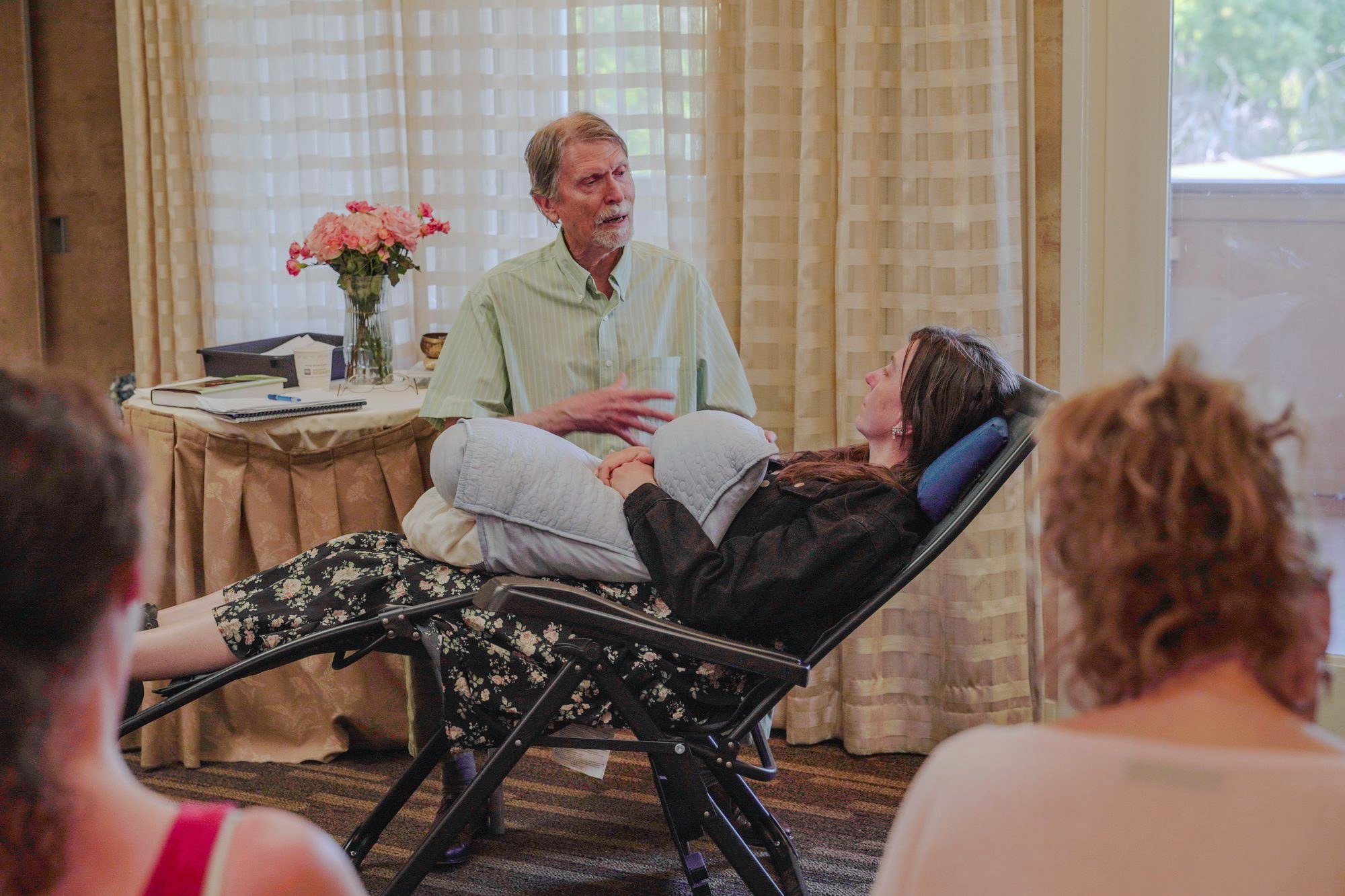
As taught at HTI, a session usually begins with a conversation about what the client wants to change and what it’s like for them now. In hypnosis, the hypnotherapist first gets guidance from the client’s subconscious and then, if it’s appropriate, may help the client follow that feeling back to a significant event at an earlier time when they felt the same way.
One widely used method, the affect bridge, described by the psychologist John Watkins in 1971, uses the feeling itself as the bridge to the past.
Another uses ideomotor signals: small, unconscious movements of a finger that answer yes or no, so the client’s subconscious can guide where the work goes. At HTI, they are taught as part of exploratory regression work. They are used to check with the client’s subconscious before emotional work begins, and again along the way, together with conversation, observation and the client’s own willingness to continue.
How a typical regression session may flow
- A conversation first. What the client wants to change, and what it’s like for them now.
- Hypnosis, and a check. The hypnotherapist gets guidance from the client’s subconscious, often through ideomotor signals, on whether to go on.
- A bridge back. When it’s appropriate, the feeling itself, or ideomotor signals, lead to an earlier time it was felt.
- The earlier experience. Reviewed from a calm distance, or felt fully and released.
- What the adult knows now. The client may bring today’s understanding to that younger self.
- Back to the present. The new understanding comes forward, allowing the client to integrate it into how they process experiences in the future.
- Session close. The hypnotherapist helps the client safely return to full awareness, allowing time to reorient and settle.
What does a regression session feel like?
Most clients are surprised by how aware they remain. You hear the hypnotherapist’s voice, you can speak and you usually remember the session afterward. In hypnosis, as Randal Churchill writes in Regression Hypnotherapy, “a person’s awareness is heightened and memories can become much more vivid,” with easier access to the emotions. Memories may return in vivid detail, or as impressions and feelings.1 Emotion often comes up. A skilled hypnotherapist remains attentive to how you are responding, adjusts the pace and allows time before the session ends to help you feel grounded and ready to continue your day. You stay in charge throughout, and you can stop at any time.
The journalist Keith Thompson, describing his own regression session with Randal Churchill, put it this way: “I knew I was free to accept only those suggestions in hypnosis which were right for me at that particular moment.” Read his account
When is regression used, and when isn’t it?
There are many forms of regression, and some are very simple. In Randal Churchill’s words, regression “can be as simple as encouraging your client to focus for a moment on a positive memory,” such as a time they felt confident. Some practitioners consider deeper regression when a reaction seems to come from somewhere earlier: a fear tied to an early experience, a pattern that keeps repeating, a feeling that doesn’t fit the present. Many goals, such as building confidence or changing a habit, can often be worked with directly, through suggestion, imagery and other methods, without regression at all. Part of a hypnotherapist’s responsibility is knowing which approach fits, how to apply it skillfully and effectively, and when it is best to refer a client to another professional.
What about past-life regression?
Past lives are among the most searched topics in hypnotherapy. In hypnosis, some people experience what seems like another time and place. Whether these are memories of earlier lives, or the subconscious offering a metaphor for experiences in this life, is a question of belief, and hypnosis can’t settle it.
Either way, the experience can be meaningful, and an opportunity for growth and learning, whatever you believe.
What good regression work takes
Randal Churchill, who founded HTI in 1978, sums up what good therapy needs in Churchill’s Recipe for Outstanding Therapy: a motivated client; a therapist who is compassionate and centered; good rapport and a positive yet realistic expectancy; and a solid foundation of methods.
In regression work, that means the client chooses to do the work and stays in control, and the pace follows the client. Because regression can reach feelings a person has carried for years, it asks a great deal of the hypnotherapist: knowing several ways to proceed, from a calm review to emotional release, and when each one is right; checking with the client’s subconscious through ideomotor signals, alongside conversation and close attention to the client’s responses; taking great care not to lead the client, to avoid creating false memories; and helping the client process what emerges, safely, before carrying the new understanding into the present. That takes thorough training, care and skill, and it’s why HTI’s training is built the way it is.
How do hypnotherapists learn regression at HTI?
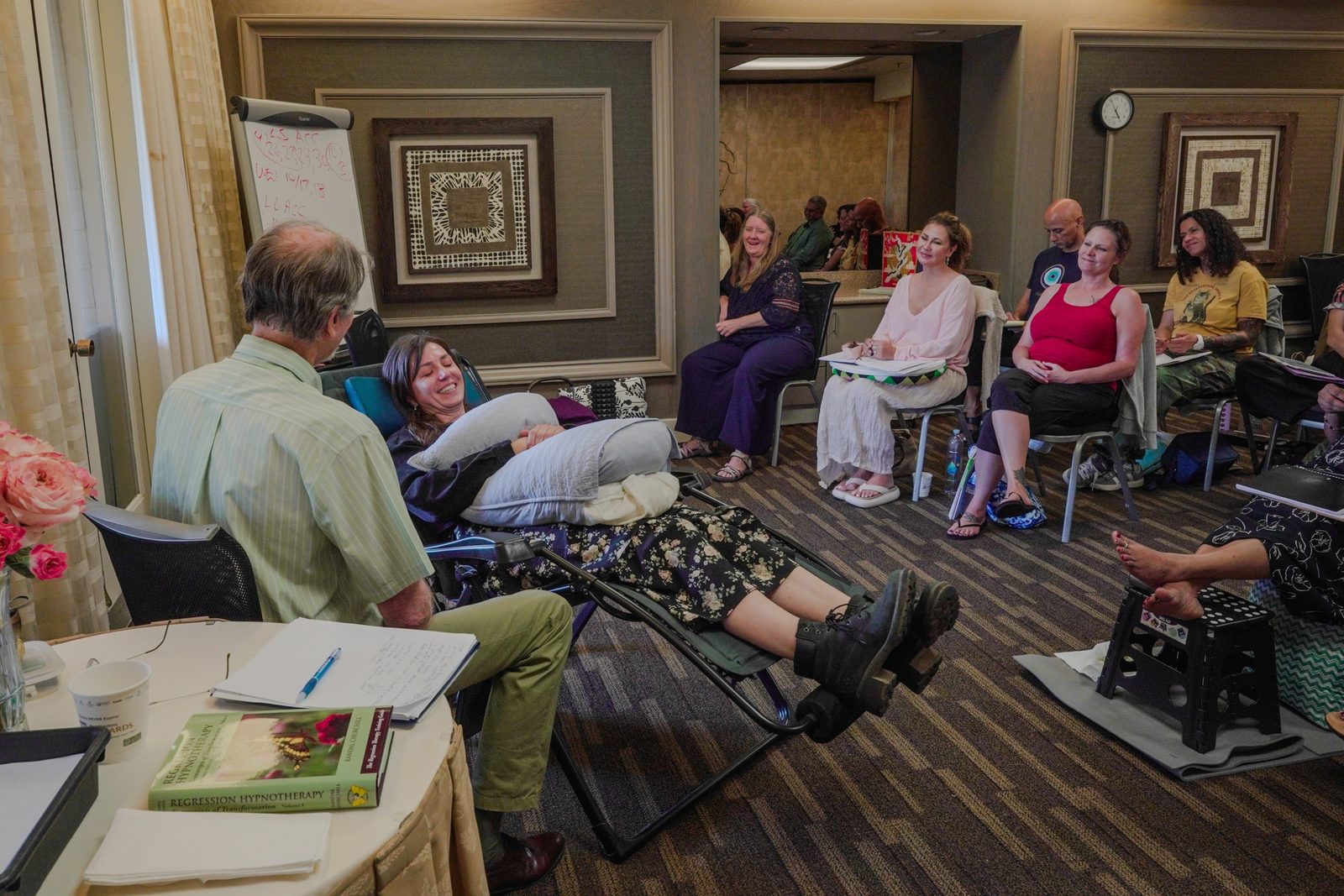
Regression is learned by watching it, experiencing it and practicing it, which is why we teach it in person. At HTI it’s introduced in Level 2 with hypnotic age regression. Level 3 takes it in depth: comprehensive regression strategies, both detached and cathartic, shown in live demonstrations, with protective ideomotor methods, the affect bridge, Gestalt and inner child work, and thorough guidance on avoiding false memories. Level 4 adds further explorations, including detached regression and Churchill’s Imprint Method™ for transforming subconscious beliefs formed by an imprint, which Randal describes as “a powerful single-impact learning experience.”
Each method is shown in live demonstrations with class volunteers, close enough to notice a breath or a finger lifting, then practiced safely in pairs and small groups, under supervision. The course texts are Randal Churchill’s Regression Hypnotherapy: Transcripts of Transformation, winner of the Founders Award for Excellence in Professional Literature, and its companion volume, Catharsis in Regression Hypnotherapy. Both present real regression sessions in detail, so you can follow how skilled work unfolds, moment by moment. Levels 1–4 give you a thorough grounding in regression. Graduates who want to go further can continue in the graduate levels, and those who complete one earn HTI’s Regression Specialist certificate.
The past can’t be changed. What a person carries from it can. That is the quiet power of regression, in skilled and caring hands.